Blog
-
New Years Eve Afternoon Links
Merry New Year! I am happy to report that I am about to drink my way out of 2019. This, the links, will be my last act of sobriety. I hope everyone has plans for a safe and responsible, excepting fireworks usage, New Year. May 2020 be better than 2019 in every way possible.
Australia is having a bit of a fire. I imagine poisonous fauna of every variety fleeing before the flames and alternatively lying in wait for firefighters.
I chuckled at the Washington Free Beacon’s Man of the Year.
Mobile PD shows its sensitive side.
Woman wakes up after being in coma for seven months. Disappointed to find Trump still President. Okay, I made up that last bit.
I was thinking about where I was 20 years ago on NYE (6th and Congress in Austin), and remembered that the girl I was dating at the time inexplicably loved this song. So, happy New Year.
-
Just So You Know Where Your Money Is Going…
As OFFICIAL COMPTROLLER for this insane asylum I’m pleased to report that we held a meeting of the Supreme Council of Masters of the Universe and decided this year to disburse our excess funds to a pair of charities that we believe you, the filthy lumpen-proletariat, will really approve of.
Minutes ago (as of my writing this; God only knows when it will be published) we donated $500 to FIRE (the Foundation for Individual Rights in Education), which dedicates itself to fighting off the worst excesses of the Kampus Kommunist Kids and their lackey administrators. We also donated $1,000 to the Institute for Justice, which has done so much to fight the army of radioactive bears that have overrun the western 1/3 of our once beautiful continent.
Thank you all for continuing your generous donations, which makes all this possible.
-
¡Nochevieja enlaces mexicanos!
¡Buenos días Gliberinos! Sloopy had to go on a short trip. Hopefully it is as lucrative as he made it sound yesterday. I’m sure Sloopy is fine.
“Buenas tardes Señor Sloopy. Yo tengo un trabajo para usted.” Don Brett preguntó.
“A job? I am all for jobs, what does the job entail?” Sloopy answered.

¡Es una buena idea! “Necesito que vueles con mi piloto, Murdock. Presente este manifiesto al inspector cuando aterrice.” Don Brett respondió.
“Murdock? You sure that is a good idea?
“Por supuesto, estoy seguro, pues.”
“Oh, well…he looks a bit short bus IYKWIM.”
“Solo dale al inspector este manifiesto cuando aterrices. Si tiene preguntas para usted, entréguele este sobre.”
“Whoa now, slow downo my Espanyolo is not so bueno.”
“Este sobre tiene su compensación y la de Murdock. No es mi problema lo que haces después de aterrizar. Murdock volará de regreso a Tampastan una vez que se entregue el paquete.”
“Murdock is doing what now?”
“Está volando a Tampastan.”
“There’s a volcano in Tampa?”
“¡Sube al avion!”
___
“You know, you’re not nearly the nut they make you out to be. In fact you haven’t really said anything at all.” Sloopy said, trying to end the awkward silence.
[[Cue music]]
“Do you hear that?” Sloopy asked.
[[Stares in Murdock]]
“Yeah, I can stare without blinking too. I give news to aspies as a hobby.”
[[Staring intensifies]]
“Shouldn’t you be flying the plane?”
[[More staring]]
“I take back everything I said about you not being a nut.”
“WOLVERINES!!!!!” Murdock yelled.
Murdock then donned a parachute, and jumped out of the plane….
 …and now for the news.
Archeologists discover a new (to them anyway) Mayan ruin on the Yucatan.
Don Brett will be making even more off sales of cocaine.
Cuban entrepreneurs create a ride share app called, “Sube” with the expectation US tourists would download and use it. I’m not sure people are actually using it.
21 people were killed in a bus crash in Guatemala.
What are the chances they shift the narrative to Venezuelan collusion?
Here’s a tune sure to aggravate everyone. Well, not really.
-
It Ain’t Easy Using a Japanese Dictionary
One of the many painful things about learning Japanese was learning how to use a Japanese dictionary. It is something that students aren’t usually taught by native Japanese. They already know how to use a Japanese dictionary and input Japanese into a PC or smartphone. It seems not to have occurred to any of my instructors to discuss how to get an alternative character set on your PC or phone and how to look up a word in a dictionary.
Japanese learners owe a huge debt to Jim Breen at Monash University in Australia. Way back in 1991 he started a project that became the EDICT / JMDict Dictionary File. It is a public domain multi language Japanese dictionary database. Prior to this most electronic Japanese to English dictionaries were expensive proprietary devices designed for Japanese speakers to look up English. Almost every dictionary application on the web and the various smartphone dictionaries use Jim Breen’s data file. So the all dictionary programs may have better or worse usability and search logic, but nine out of ten times the definition they provide will be identical. The exception to this is the dictionaries designed for native Japanese speakers to look up English. That’s a topic for another day.
As an Android user the dictionary on my phone that I use all the time is called Aedict. One of the interesting things about whatever he used to develop the application is that he als runs a web version that is identical to the phone application. It’s available here:
So let’s suppose that you are reading some Japanese and come across the following word:
出る
What do you do if you have no idea how it is read or pronounced? If it’s on the computer the easiest thing to do is copy the word and past it into the dictionary. If you can’t do that you got several options each of them increasingly annoying. First, let’s suppose you actually know the reading – in this case it is “deru”. I can type that in romaji right into the search box.

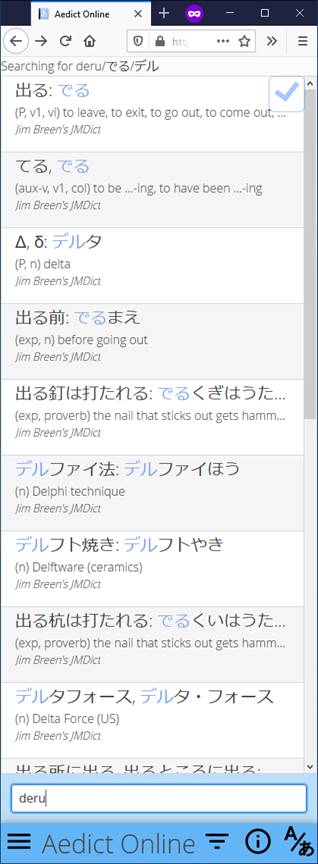
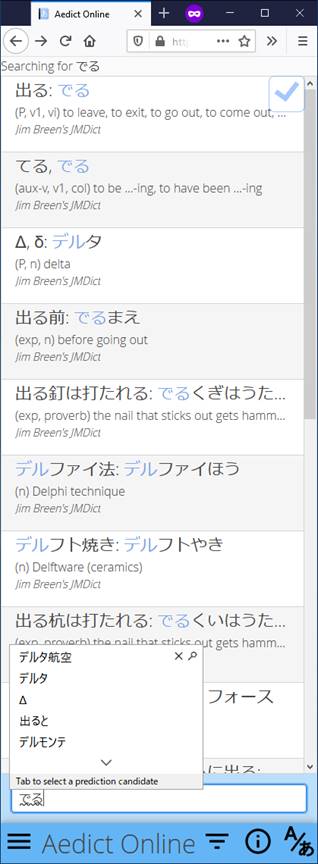
Your second option is to actually type the word in either hiragana or katakana. The dictionary will recognized the hiragana or katakana the same as if you used romaji. However, your phone (or here my Windows 10 PC) will also bring up list of characters that are written with those same hiragana characters. Take a look in the middle of the box in the second illustration.
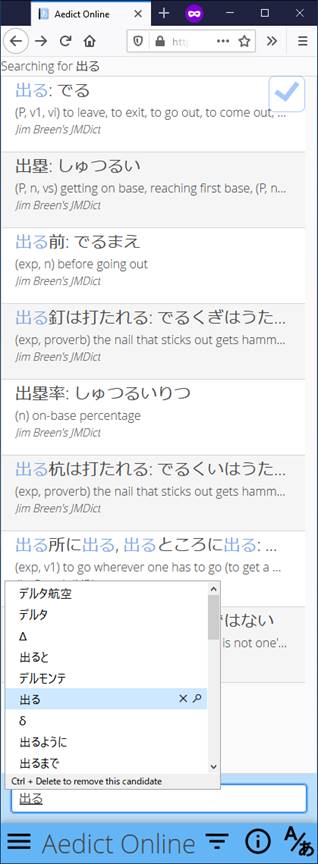
Next, let’s suppose the character is physically written somewhere and you have no idea what it means or how to read it. You have several options. Below you see icons for a paintbrush or fude brush a puzzle piece and 4-1-4.
I’ll skip the puzzle piece and 4-14 approaches as those particular methods work based on the structure and shape of the character and the number of strokes and are even more complex. Instead let’s focus on the paintbrush. We can actually draw the character right on the phone! (Or in the example below with my mouse – which explains why it looks so bad.)


The problem is that all of the character drawing applications for Japanese assume a basic knowledge of stroke order and number and type of stroke. In the first example above I drew the character with the proper number and type of strokes. You can see at the very top the very first character the application guessed is the correct kanji. The second character may look drawn almost exactly the same, but it isn’t.
Look in the middle of the illustration – it says Strokes: 6. This character is only drawn with 5 strokes. In small stroke character like this it isn’t too problematic, but in significantly more complex characters adding or missing a stroke can make this particular input method daunting. You can see there is a check box to allow the program to guess +- 2 Strokes. Sometimes this works and sometimes it doesn’t.
Below Aedict displays both the proper way to draw this character and the definition. I picked “deru” because I find this word maddening. It usage matches up to multiple different English meanings. The definition scrolls on beyond what I have displayed here.
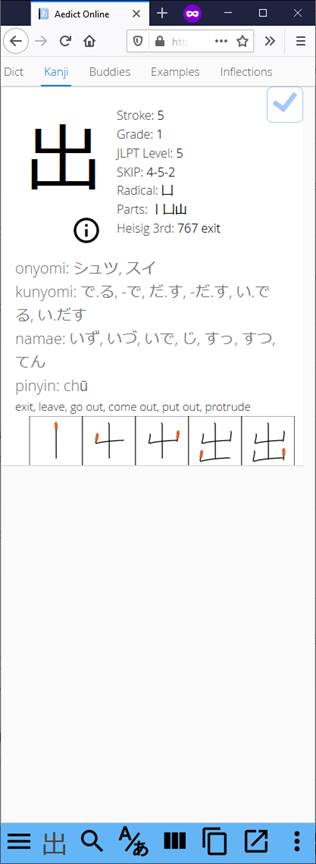
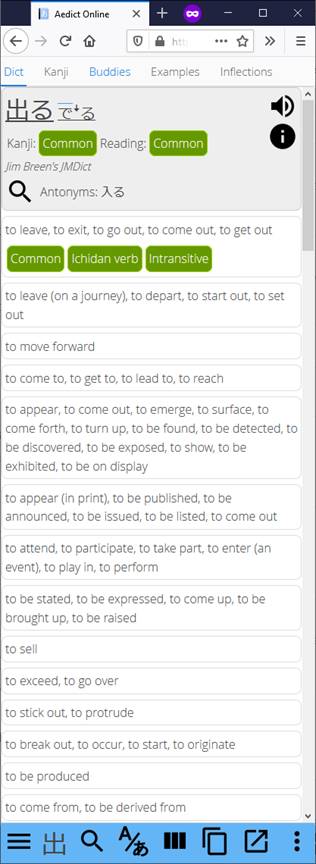
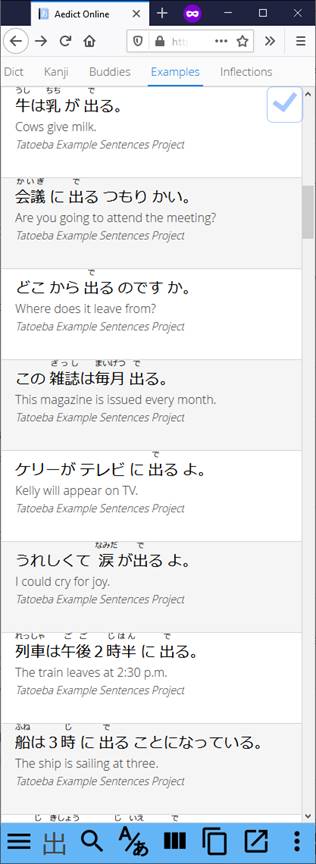
The application also provides other words and other readings that use the same character. It also uses another wonderful public domain project called the Tatoeaba Project that a collection of Japanese sentences and translations in multiple languages.

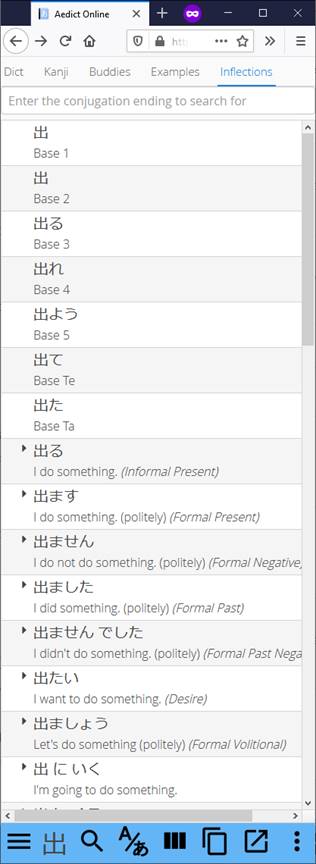
And finally because I chose a verb to look up the dictionary program tells us how to inflect it to make various grammar forms like present and past tenses. In the old days you used to have also input verbs into electronic dictionaries in what is actually called “dictionary form”, but now most dictionary programs, including this one, will “de-inflect” verbs so that you can simply input the word as you read it. That was huge deal because certain Japanese verbs are inflected in one of five ways and it can be difficult to tell which of the five was to use to get the dictionary form.
There you go! Simple right? Happy Japanese learning everyone.
-
Ultimate Monday of the Decade Afternoon Linkstravaganza
Haha, just kidding, its the usual mailed-in links, but I wanted everyone to feel excited about the last Monday of 2019. I have been experimenting with some new M$ technology at work, and was all “oh, this M language for Power BI is garbage language because it takes 8 zillion steps to write the same thing I can declare in a single SQL query.” Turns out you can just drop a native SQL query in there. So now I am Power BI expert!
Who are these garbage people who hold these garbage opinions?
I think none of us are surprised by this, but I want to ask a counterfactual: Could our economy even stand it if Trump tariffs weren’t slowing the growth from explosive to rocket-powered?
For some reason, “socialist” is a pejorative term with Florida Latinos… maybe lived experience has something to do with that.
While the rest of the US is rapidly attaining 1920’s levels of wealth, growth, and opportunity, NYC is racing towards the late 70s. Time for an Escape from New York remake!
Well, let’s rock into 2020, start now, wake up by Thursday morning!
-
Thirty-Something Rifle Cartridges II – The Thirty-Threes
Thirty-Something Rifle Cartridges I: The 33s
I find the thirty-threes to be some of the most useful of the thirty-something calibers for the North American game fields. Most of them are easily capable of taking the largest American big game. There is a wealth of projectiles available. Some of them, like Winchester’s excellent .338 Winchester Magnum, have been around for decades, and as a result there is a great deal of loading data available.
As a result, there are a lot of .33 caliber rounds out there to discuss. So, without further ado…
At the End of the Black-Powder Era…
 As we saw back in the series on level guns, the famous John Browning/Winchester collaboration started with a big, tough lever gun called the Model 1886, which could handle some pretty heavy cartridges. In 1902 Winchester made this rifle available for a new cartridge, the first commercially available thirty-three, the smokeless-powder .33 WCF.
This was a pretty hot load for its time, launching a 200-grain cast bullet at 2,200 fps. With more modern, jacketed bullets, it quickly gained a reputation as a hard hitter, ideal for deer, elk and bear at ranges out to about 200 yards. Besides the Model 1886 Winchester, it was also available in the 1885 single-shot and the lever-action 1895 Marlin.
The .33 WCF was interesting because it came at a transitional moment in American shooting. As we’ve noted previously, the end of the Great War resulted in a lot of American shooters and hunters returning home with the memory of their issue 1903 Springfield and Pattern 17 Enfield bolt guns in mind, along with the powerful .30-06 round they fired. The lever gun was due to lose some popularity; the age of the bolt gun was dawning.
And the .33 WCF, while a groundbreaking round, was a rimmed lever-gun cartridge.
The .33 WCF was offered in the Model 1886 until 1935, when Winchester replaced the 1886 with the beefier Model 71 and its .348 Winchester cartridge. But this first of the thirty-threes had set the stage for some modern bolt-gun rounds to come, and one of those pioneering bolt-gun rounds came (in part) from the mind of someone we’ve discussed before: Elmer Keith.
The Mid-Century
Early in the 20th century Elmer Keith, along with his colleagues Charles O’Neil and Don Hopkins, developed a new .33 wildcat based on the .30-06 case necked up. The .333 OKH was intended to use the same .333 diameter bullets as the .333 Jeffries then popular in Britain, and while it delivered some good performance it was hampered by the lack of bullets, and since wildcatters live and die by the availability of suitable projectiles, this didn’t bode well for the .333. The logical evolution was to increase the bullet size to .338, resulting in the .338-06 wildcat.
This same trio also developed the .334 OKH, based on the .375 H&H case; this ended up being remarkably similar to the .340 Weatherby Magnum, about which we’ll talk in a moment.
 In fact, the tale of the mid-twentieth century thirty-threes is somewhat convoluted, with plenty of wildcats and experiments mixed into the developments by major gun and ammo manufacturers. But one thing very quickly became apparent – launching a big, heavy projectile at significant velocity called for a magnum-sized case.
Precedent was already in place. During WW2 Roy Weatherby had introduced three standard (2 ½”) length cartridges based on the .375 H&H belted case, shortened and necked down. These three were the .257, .270 and 7mm Weatherby magnums, and they soon gained a following among those fond of high-velocity rounds.
In 1958, at the urging of Elmer Keith, Winchester took that precedent and applied it to Keith’s and others work with the medium bores. They followed Weatherby’s example, took the .375 H&H case, shortened it to fit standard-length actions, straightened the case walls a tad and necked it down to take a .338 pill.
The result of this was the great .338 Winchester Magnum, introduced along with the .264 Winchester Magnum and the .458 Winchester Magnum as a family of cartridges.
Now the American sportsman had a real world-beater. The big new medium-bore magnum put out a 225-grain projectile at 2,800 fps in factory loadings, and with the right slug would easily handle any North American big game, including big Alaskan grizzlies and moose.
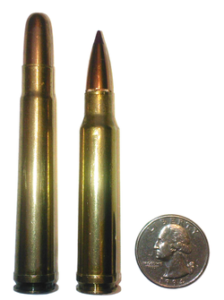
The .375H&H, .338 Win Mag, and a quarter for scale. It should come as no surprise to anyone that’s been paying attention that this round is a favorite of mine. My .338, Thunder Speaker, is built on a 1908 DWM large-ring Mauser action with a Douglas barrel and a Bell & Carlson stock. The .338, while delivering plenty of punch, does it on both ends, having a reputation for recoil as well as hitting power. Thunder Speaker, in addition to the big, wide recoil pad on that B&C stock, is Mag-Na-Ported and weighs almost ten pounds loaded, which makes it very manageable – at least for me. I’m large and not recoil-sensitive, so your mileage may vary.
My favorite load in that big, tough Mauser action is a 225-grain Barnes TTSX boat-tail over 67 grains of IMR 4350. This gives me about 2,800 fps for almost two tons of muzzle energy. This load will easily lengthwise an elk or moose, and that’s what Winchester intended the round should be able to do, so I’m pretty satisfied; in Thunder Speaker, with me at the wheel, it will also put three rounds into a 3” circle at 200 yards. The best shot I’ve ever made on a game animal was with this rifle; a fat meat mulie buck in the open sage country south of Parshall, Colorado. The buck paused to look back on the edge of an arroyo; I tossed my cap on a flat rock, laid down in the snow, laid my rifle on the rock, took aim and sent one round down the hill. The .338 slug hit the mulie at the base of the neck, dropping him in his tracks at 280 yards.
She still does kick, though. My son-in-law once got a case of Kaibab eye after asking to try out Thunder Speaker off the bench-rest; I warned him not to choke up on the scope!
The .338 Winchester Magnum was quickly a big commercial success. In addition to its introductory chambering in another shooting legend, the pre-64 Winchester Model 70, it was quickly picked up in the Remington and eventually, the Ruger, Savage and many other lines. Browning made it available in the BAR, making it the most powerful semi-auto rifle available at the time. Wildcatters quickly picked up on the usefulness of the case, bringing about among other things the .30-338 Magnum, which Winchester later legitimized as the .300 Winchester Magnum – bringing the standard-length magnum case back to America’s caliber.
But the competition was paying attention.
 Only four years after Winchester brought out their thirty-three, Roy Weatherby upped the ante. His entry into the field was the .340 Weatherby Magnum, on the same magnum-length case as the .378 Weatherby Magnum. This was a real whopper, sending the same .338 225-grain slug forth at 3,100 fps. But the .340 Weatherby suffered from the same issues as the 8mm Remington Magnum we discussed in the last installment: It was limited to a magnum-length action. What’s more, it was a proprietary round. When the .340- Weatherby was introduced one could only have one in the Weatherby Mark V, with factory ammo initially only available from Weatherby. Even today, the only company loading this round besides Weatherby is A-Square, and the ammo is pricey.
The place of the thirty-three in the American shooting scene was now secure. But the explosion of rounds to come was to prove an embarrassment of riches.
Today
In the magnum world, the .338 Winchester Magnum and the .340 Weatherby Magnum have been joined by some new contenders. The .338 Ruger Compact Magnum came out in 2008, a 2,700fps thumper intended to be chambered in short-action rifles like the M77 Mk II Compact.
 There are a couple of newer Weatherby-level steamrollers available as well. In 1989, A Norwegian/Finnish munitions company named NAMMO (Nordic Ammunition Company) saw a market for a powerful, long-range military sniper round; their answer was the .338 Lapua, which was adopted in civilian as well as military applications. The Lapua is a real rocker, sending out a 250-grain slug at over 3,000 fps.
In 2002 Remington responded with an expansion of their Ultra Magnum line, the .338 RUM (Remington Ultra Mag.) This fell a bit short of the .338 Lapua and produces very similar ballistics.
But both ultra-mag rounds have the same shortcomings: They both require magnum-length actions, and they both run at very high pressures, resulting in significant barrel wear at a much lower round count than the older .338s. Still, there’s still news in the non-magnum world.
2006 saw the introduction of the .338 Federal, which was simply the .308 Winchester case necked up to the .338. This introduction not only gave .33-caliber thumping to short-action bolt guns, but it also added a medium-bore alternative to the AR-10 platform that was becoming popular as the Tacticool craze accelerated. The Federal round yielded only modest performance compared to the magnums, propelling a 210-grain slug at about 2,600 fps. But the use of the .308 case made for a versatile round that punches well above its weight class.
 Finally, in 2009, Marlin brought the thirty-threes full circle by introducing the .338 Marlin Express, a semi-rimmed lever-gun round intended to punch up the power level of that company’s 336-series rifles well above the original .30WCF level. In fact, at ranges up to about 200-250 yards, the Marlin Express round delivers performance in excess of most .30-06 loads, which makes the 336 rifles far more versatile on bigger, thicker-skinned game – and brings the lever-gun world back to the levels of punch known in the original 1886 Winchester.
The thirty-threes are many, powerful and versatile. The late 20th-early 21st century proliferation of .338-caliber rounds has been interesting, but none of them have quite managed to knock the good old .338 Winchester Magnum off the top of the heap.
In the next installment, we’ll examine a group of rifle cartridges that are a little lighter on the long-range magnum loudenboomers and a little heavier on the short-range woods rounds – so stay tuned for an in-depth look at the thirty-fives.
-
Monday Morning Links

Dawg Pounded Well the year is all but over. And it isn’t ending well for Freddie Kitchens. And I’m not sure it will end with Jason Garrett as coach of the Cowboys. There will surely be more heads on the chopping blockout those two are the biggest names. The winners yesterday were: Miami (forcing New England into a Wild Card round game for the first time in a long time), NYJ, the Bungles, Packers, Chiefs, Bears, Falcons, Saints, Cowboys, Broncos, Rams, Eagles, Jags, Ravens, Titans and Niners.

A common sight on Merseyside Now let’s talk about who the year ended well for: Jurgen Klopp. His team haven’t lost since January 3. And the EPL is on straight up lockdown, as they’re 13 points clear of second place with. game still in hand against team barely above the drop. Let’s hope they keep it up.
Roman emperor Titus was born on this day. As were author Rudyard Kipling, warming Japanese PM Hideki Tojo, musical legend Bo Diddley, pitcher Sandy Koufax, Monkees Davey Jones as well as Mike Nesmeth, Patti Smith, Jeff Lynne, powerlifter Kill Kazmaier, TV’s Matt Lauer, Canadian steroid user Ben Johnson, prostitute-to-madam Heidi Fleiss, golfer Eldrick Woods, basketball team-hopper LeBron James, and the lovely Eliza Dushku.

Duuuuuuushkuuuuuuu! That went from music-heavy to sports-heavy and really ended up being a big day of birthdays. But now it’s time to get down and dirty with…the links!
Rep John Lewis has Stage IV pancreatic cancer. Of course he won’t leave congress so someone else can do the job. He want’s to go out like John McCain and take a victory lap around Washington so everybody can kiss his ass. Nevermind that he won’t be able to effectively represent his district.
There are actually dumbasses out there saying this is why we need gun control in places of worship. Seriously, they think gun-free zones wound have made this better instead of making sure the shooter had nothing but unarmed targets.

Out on bail It sounds like this guy might be involved in more than the Hannukah stabbings. And they’ll be painting him as a Trump supporter in 3…2…1. I mean, why not? There are already a lot of talking heads saying that Trump being so supportive of Jews is what’s causing people to lash out at them.
Speaking of the guy above, if he’s not married, I think I could set him up with this chick. She seems like a real peach.
Jesus, talk about out of touch. I mean…Jesus, talk about out of touch.
There’s still a couple days for the stock market to go wild one way or the other. And stability is pretty much all up to the Norks and China not going apeshit crazy.
Enjoy. I will.
Now have a great day, friends.
-
Sunday Evening Open Post

Comment time Sunday Evening. You know what to do…the comments are all yours.
-
GlibFit 4.0 – WTF is Chrononutrition?
Since Thanksgiving there have been two strains of comments among the commentariat that read the GlibFit articles. First, those of you who in some way, shape, or form, write something related to the article to help your fellow Glibertarian. Second, the few who think trying to exercise and/or eat right between Thanksgiving and New Years Day is a fool’s errand.

As part of the discussion, one of you offered up chrononutrition. I’ve looked back through the comments and tried doing some searches on the site to find who to credit but my web skills are poor. Whoever posted this article, thank you.
I’m no scientician but I found the ideas in the article intriguing. The author was obviously aware of the Glibertarian audience for his work. He kindly gave us a TL; DR version:
- Circadian biology plays a fundamental role in human health.
- Research has shown that nutrient ingestion can impact our “body clocks” in peripheral tissues around the body, suggesting that when we eat our meals can have implications for health via influencing circadian rhythms.
- In addition, it has been hypothesized that having a restricted feeding window (time-restricted feeding) can have beneficial impacts on body composition and health, likely via circadian effects at least in some part.
- A related hypothesis suggests that the distribution of calories over the day (majority eaten early vs. late) can also have health impacts.
- My personal interpretation of the current literature available leads me to tentatively conclude that, in general, the following heuristics would be beneficial for many people to follow: 1) avoid eating during biological night, 2) avoid meals, particularly those high in fat and/or carbohydrates, close to DLMO (or say, at least ~2-3 hours pre-sleep), 3) bias more calories to earlier in the day (i.e. don’t eat a high proportion of your daily calories in the late evening), 4) have consistent meal times and meal frequency from day-to-day, 5) have some restricted feeding window (start with <12 hours per day, but no ideal is yet known), 6) get daylight exposure early in the day and avoid artificial light (blue and green wavelengths of light specifically) as much as is pragmatically reasonable at night.
- There are several caveats and exceptions to the above heuristics. Implications may be different for athletes, for those trying to gain weight, for those who such heuristics undermine adherence to nutrition fundamentals, and in situations where social interactions and fun should be prioritized.
I’m going to give this a try. I’ll probably need to eat a bigger breakfast and lunch. Adding a more substantial afternoon snack should make it easier to eat a smaller dinner. Eating more than two hours, much less three, before going to sleep is going to be a challenge. I tend to have long workdays. I’ll need to work this one out. Though I will say all the late-night banter makes it easier even if it does deprive me of the sleep I need (I’m looking at you Sir Digby, CPRM, Festus, and Straffinrun.)
Let us know in the comments if you have used these ideas and how they worked (or didn’t) for you. I’m curious to know if anyone with experience finds this sustainable (or not). I don’t mean perfectly abiding by this program at all times. I do mean making this a regular routine subject to life’s occasional disruptions.
Another angle I’m curious about is anyone who has done this and exercised at night. This is a possible exception as noted by the author. I’m reading David Goggins’ book in part to motivate me to up my fitness game. I strongly suspect this is going to mean, for me, continuing with lifting in the morning and adding HIIT and ab work in the evening after work. I can’t tell if that’s compatible with the author’s suggestions.


